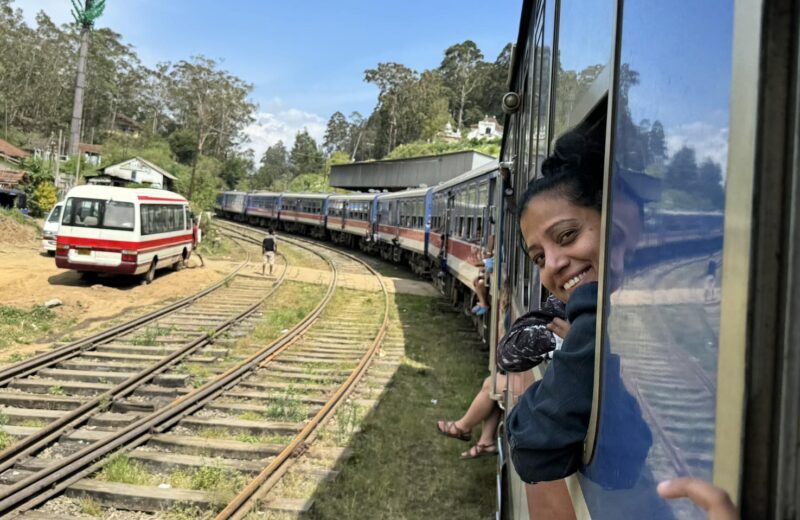
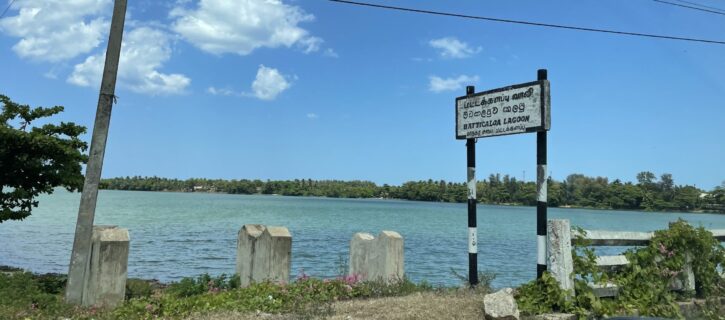
Batticaloa, on the east coast of Sri Lanka, has a distinct tropical charm. This culturally and racially diverse town is about five hours’ drive from Colombo or longer by train that passes through several topographies, even crossing elephant reserves and vast paddy fields and grasslands on its way here.
My travel by road ensured I reached the town while it was at its humid best. That, however, did little to dampen the excitement of being here.
The roads were wide and clutter free, clock towers and parks brightened the ageing town. Scores of Hindu temples, churches, mosques and remnants of colonialism in the form of low, whitewashed bungalows, made it a town worth exploring.
A peek into the past
Batticaloa stand on the land between the lagoon and the Indian Ocean. In Dutch, Batticaloa means Kingdom of Paddy. However, the original name of this region is Matakkalappu (Tamil), but the most romantic of it all, I learnt, is the nickname Land of the Singing Fish.
Tamils and Muslims make up most of the population here with the majority working in government sectors (Kacheri), the offices of which are located the town’s star attraction – the Dutch Fort.
The ‘Dutch Fort’ however, was built by the Portuguese in 1628. It was captured by the Dutch in 1638 (who rebuilt and fortified this fort) and later fell into the hands of the British. It is protected by the brackish waters of lagoon on two sides and canals on the other two.
The Batticaloa town is vast but with no visible high-rise buildings and is dominated by the Dutch Fort, an iconic gold-coloured statue of Mahatma Gandhi on a cement pedestal and the Batticaloa Gate, which was the port entry where boats connected Pulliyanthivu Island to the mainland. There are two theories of how this island got its name. One is strictly connected to the abundance of tamarind trees (Tamil for tamarind is pulli) and the second is rooted in the belief that there was a clan of folk called Pulinther in the region – thus the name Puliyanthivu.
All this exploration was easily done in a couple of hours after which I proceeded to my next stop with much eagerness.
It was time to revisit a legend.
Legends of the singing fish
Thus, I proceeded to the Kallady Bridge, another of the town’s attraction for two reasons – one, it was the longest bridge in the country when it was built and second, it was here the legend on the singing fish originated. At the entrance of the bridge is a statue of the Tamil poet Auvvaiyar, carrying her bag and a staff. The bridge itself is not in use today but it is interesting to walk over it and admire the vastness of the lagoon fringed by tall coconut palms. The lagoon is nearly 56km long – stretching from Eravur (north) to Kalmunai (south) but the area close to the bridge is where true legends come alive.
On a small boat we set out on the lagoon to witness the legends of the singing fish.
The boatman who hailed from a family of fishermen, sang softly as he coaxed the boat further into the lagoon, whispering to the water and sometimes cursed the jelly fish. Then suddenly alert, he would dig the oar into the lagoon and put the other end to his ear as if waiting for an orchestra to begin and launch into imaginary stories of giant fishes found in these waters.
Soon we were almost in the centre of the lagoon having seen nothing but sting rays. The sun went down, but the evening was clear and cloudless and there was still some light left. The fisherman then handed me the oar signaling me to follow his lead. I pressed one end of the oar against my ear and the other into the water and waited. I swear I could hear my ears ring, but that is all. No fish were singing that night and the oars did nothing to amplify the sound of the legendary underwater music made by the fish.
The legend says that the singing fish helped fishermen navigate the lagoon, leading them to their catch on dark nights, but with time, they seemed to have disappeared. Today, not even people passing through the Kallady Bridge can hear them, although on occasions fishermen still claim encounters with these elusive musicians. Some say the singing fish are particularly active on moonlit nights. This entire business is shrouded in mystery even today, despite the proof that in 1954 a priest named Fr. Lang, made the first audio recording of the singing fish, which was later aired over Radio Ceylon in 1960.
Since then, there have been no such audio evidence of this mysterious phenomenon, but tourists continue the search in hope. Legends aside, a boat ride on the lagoon certainly makes for an interesting evening.
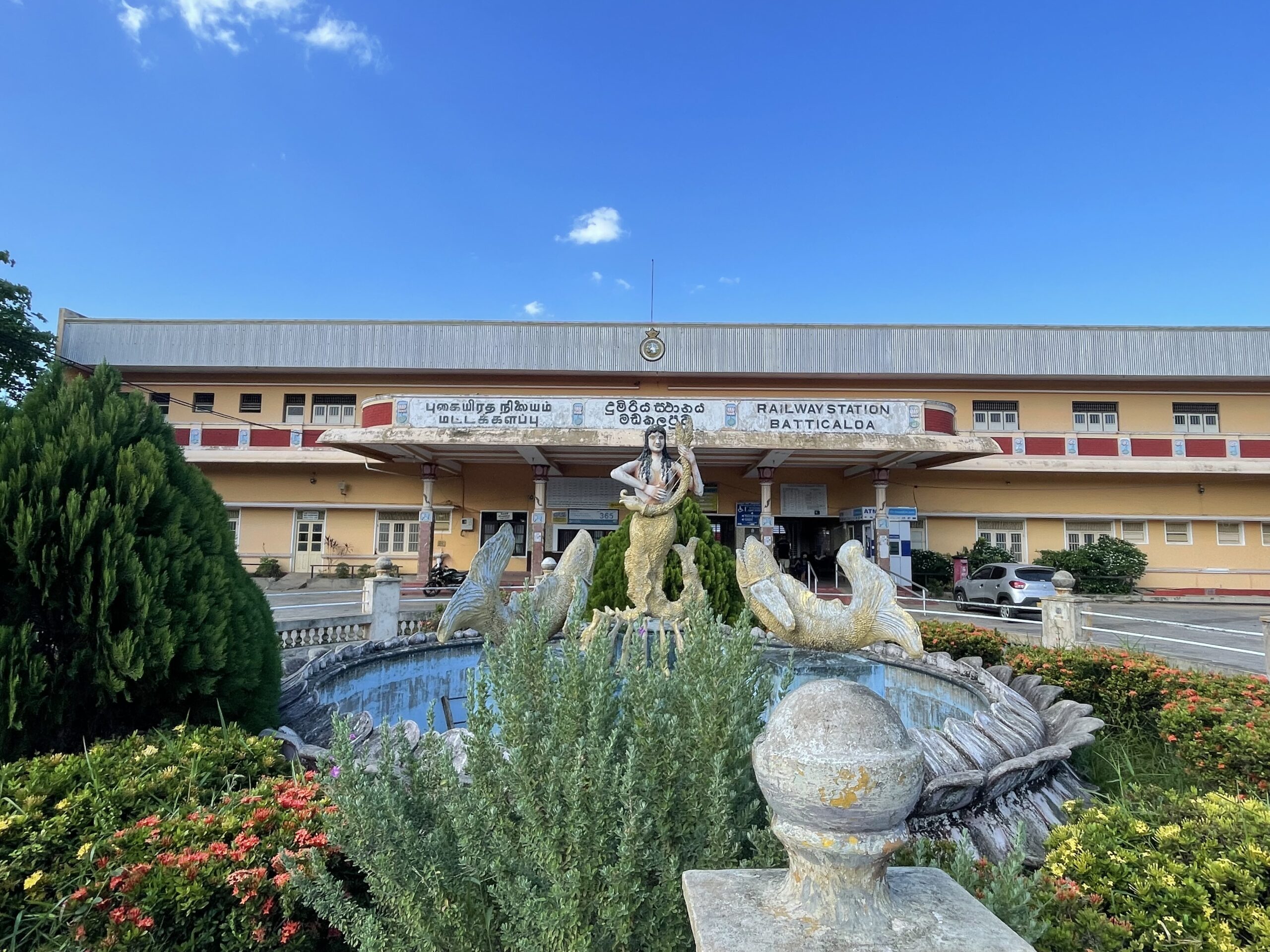
The Green Algae Bay
Batticaloa lays no claim to long and wide beaches, although there are many villages around it that are preferred for a relaxing holiday. One such was Pasikudah, thirty-five kilometers away, where I would spend the next couple of days, enjoying the blue waters and long walks on the famed white beaches.
It was dark when I arrived at Sun Siyam Pasikudah located on the shores of the horse-shoe shaped bay with a dense green cover to which I was particularly thankful. Despite the late hour, it was still warm.
There was a good reason to be here. In Tamil, Pasikudah means Green Algae Bay – but I had to wait until the next morning for the meaning of that word to make sense.
A short walk from my room, I arrived at the beach. It was almost time for sunrise. Through the two slanting palm trees I watched the sun begin its journey. It was magical. The dull grey reef that protected the beach from the ocean slowly changed colour – going from night-grey to a stunning turquoise in a matter of minutes. As I watched, the sands sparkled, the palm trees swayed, and a cool ocean breeze blew up the reef bringing with it the much needed cool. A local fisherman walked by with his treasure trove of conch shells. In the safety of the reef, I swam till the tide rolled out. In fact, this beach is considered to be safest in the country.
Yet, in my heart I knew that the best was yet to come.
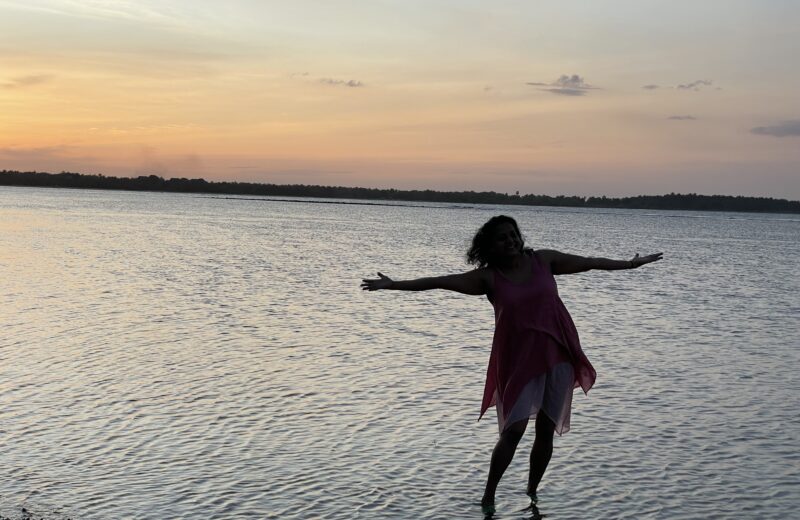
In the evening, I stood on the exact same spot where I watch the sun rise – only this time I turned westward – waiting for that moment of magic when the sun would go down. Like I’d been told that moment came soon enough – and when it did, Pasikudah was bathed in a pinkish light.
Some say Pasikudah is the best way place to photograph the Milky Way but that moment all I knew was for the first time in my life, I had managed to watch the sunrise and the sunset from one spot.
That was the real magic of the Green Algae Bay.