I dare say, and in no uncertain terms, that Rwanda is the Switzerland of Africa, a statement sure to invite refusal and acceptance. Lying in the shadows of its more famous neighbours like Uganda, Tanzania and Kenya, it is yet to become a top-of-the-list tourist destination but it is set to change that too.
Rwanda is a country shaped out of horrific human disaster to become what it is today – a spotlessly clean country where forgiveness reigns supreme, where safety is top priority and where your travels actually lead to a better understanding of humanity.
I have spent a lot of time in this country (having travelled there thrice), sometimes staring at fields of pili pili (a variety of hot chili) and poultry farms, walking through tea-plantations and sometimes lounging by the pool in the famed Hotel Des Mil Collines (Hotel Rwanda) wondering how twenty three years could make such a difference. I traveled on buses and bodas, not for a moment feeling I was in Africa. My inability to converse in French was a small stumbling block.
Back to the beginning
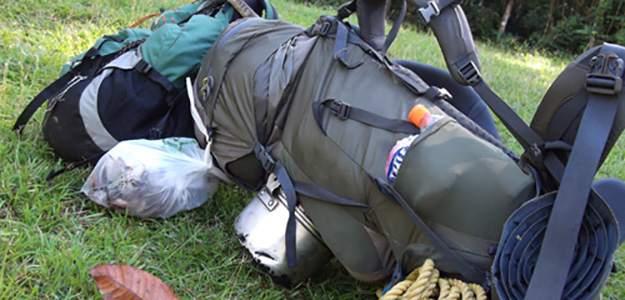
Rwanda is a plastic-free country the evidence of which you can see at the airport.
“You must remove the plastic from your backpack,” said a friendly officer. “You may not take plastic into the country.”
I wanted to tell him that I had been forced to wrap my backpack. But as I unwrapped my luggage, I smiled. Rules were a funny thing – they either made you glad or resentful. I was glad to see note how serious they are about preserving the natural balance of their country.
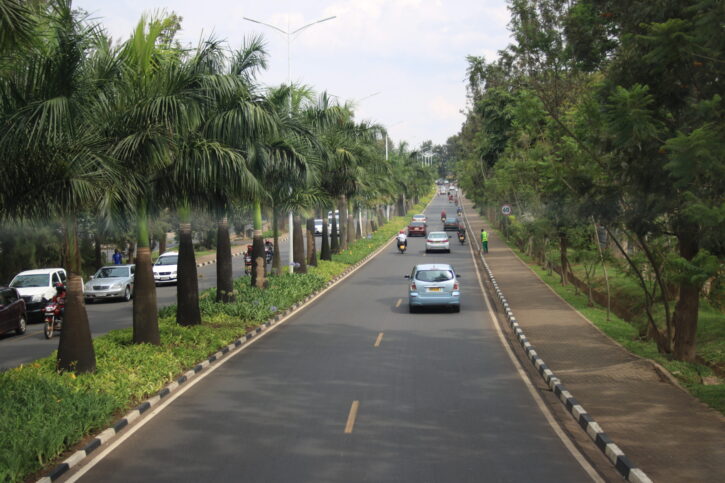
Kigali is easily the cleanest city in Africa I’ve seen. Let me go a step further – it’s cleaner than most European and American cities I have seen. There was absolutely NO litter. And even better – no noisy matatus, honking boda boda’s and no hawkers.
A whole new Africa!
I checked into my guesthouse at Kimironko and set out to explore right away.
“My friend,” I told a boda driver. “Show me your city. Go anywhere, show me everything. I want to feel your city.”
He quietly turned on his bike- meter, handed me a helmet, smiled and kicked his motorbike to life.
We rode through wide, jacaranda lined streets towards the city centre. The buildings shone in the mid-morning light, mercury hovered at about 21, there was a light breeze – I closed my eyes and imagined myself elsewhere. I could not. No other place could trigger that feeling of belonging. That feeling was brought on by Africa alone – it had my soul.
Understanding the geography of Kigali can be slightly daunting. Here, you were either riding upwards or downwards with short stretches of flat ground. I suggested coffee. Upon my insistence, he accompanied me to the coffee shop.
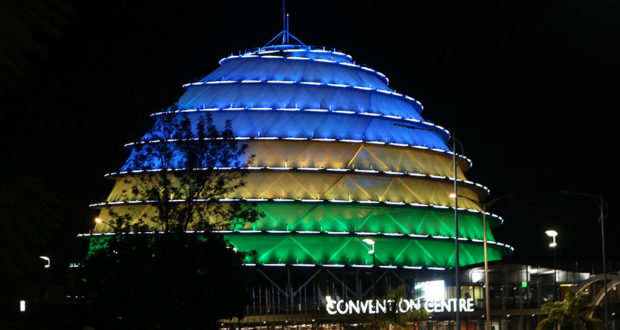
Jave House at Kigali Heights on KG 7 Avenue is a rather upmarket area facing the Convention Centre, one of the most expensive buildings on the continent of Africa, built at a whopping $300m. From the wide terrace of Kigali Heights, the city of Kigali appears as an ultra-modern, well-maintained city. Traffic is disciplined and not even a piece of paper or cigarette stub ruins the perfection this city has managed to achieve.
We proceeded to the Genocide Memorial in Kisozi District, about fifteen minutes away.
“I will wait for you here,” said the driver, stopping his bike-meter. “You take your time.”
I spent an intensively powerful and moving one hour at the centre, looking at pictures of victims of the 1994 genocide that destroyed nearly 800,000 lives in the country. As I progressed from room to room, the imagery got disturbing and I was forced to abandon my visit. Not many visitors at the time were dry-eyed. The images of Tutsi children who’d fallen victims to the machetes refused to go away.
By lunch time, I had lost my appetite and repaired instead to Hotel Des Mille Collines (Hotel Rwanda), in continuation of my understanding of genocide.
My boda-meter stood at a mere 8,000Rwf (about $8).
Hotel Rwanda is Rwanda’s oldest star-rated hotel and besides being a luxury property, is a tourist attraction. Having been at the center of 1994 Rwandan Genocide in 1994, its role was made famous by a Hollywood film Hotel Rwanda in 2004 starring Don Cheadle (although the film wasn’t shot here).
Late in evening I went up to the roof top restaurant aptly named Panorama. I was mesmerized by the sheer beauty of the city that appeared like waves of sparkling lights. There were lights as far as I could see. As I watched, rainclouds appeared followed by lightning flashes and rain. And as though it was possible, Kigali turned even more beautiful.
Day 2
I left on a three hour bus ride to Gisenyi the following morning. Just as striking as the city had been at night, the views of green terraced hills, eucalyptus lined roads, tea plantations and fields of vegetables that stayed through the journey was a reward in itself. The roads were great, with proper shoulder; law-abiding drivers were respectful to cyclists. There were hardly any roadside stalls selling food in the open, no animal crossed the roads. Every town we passed by was clean and tidy. Rwandese people had clearly distinguished themselves from the rest of Africa.
We arrived at Gisenyi, a beautiful town on Lake Kivu, feeling a little as though I’d arrived at a French village.
My noon I had lunched on sambasa (a finger-sized fish from the lake) at my hotel and promptly established myself on a low chair by the lake for a nap. Here at last was real peace and quiet. Gisenyi was clearly standing up to its name. Rwandese came here to relax and definitely no one left without feeling the magic of silence here. I was beginning to see the truth of that.
I woke up to the smell of coffee. A uniformed waiter was standing beside me bearing a tray on which reposed a steaming cup of coffee. I realized that I’d instructed them to fetch me a cuppa at 4pm. Was it 4 pm already? I waited for the sunset over the lake and ended up seeing swarms of bats arriving for their evening hunt.
In the late evening I strolled around town, not really looking for anything. In Rwanda, I had come to realize, not everything must have a purpose. The night came quickly bringing with it a different rhythm and charm. The otherwise sleepy town transformed into a hive of activity centering round watering holes, of course. A distant lazy beat picked up and exploded into euphony of sounds. The night had begun. I ate brochettes for dinner, a Rwandan favourite and retired for the night.
Day 3
The morning was a fine one. I headed to the public “beach’ – a long sandy stretch on the Lake Kivu and watched fishermen sail across the lake in their traditional boats, singing. Perhaps they’d have a good catch of sambasa today?
Gisneyi was not a morning –town, so to speak and once the sun was up, the lake lost appeal. It was a pretty laid back town and I had to dig deep to find something to do – a fine line between relaxing and getting bored, I might add, so I headed to the main market to look for Congolese masks. The market was so orderly and prim that I actually missed the chaotic appeal of African markets. Rwanda, I felt, needed to entertain itself somehow. It felt rather un-African in every way.
I turned down the idea of going to the hot spring and the tiny island off shore, opting instead to walk along the Avenue of cooperation, a long tree-lined lane going around the Lake right up to the border with Congo, returning in time for the ubiquitous Rwandan buffet-lunch. A plate of crispy fried sambasa was a special order!
I caught the evening bus to Kigali.
Day 4
Nyamata Genocide Centre was some distance away from Kigali, but getting there was easy. Not a lot of visitors came here, but the caretaker told me it was a very important site. As we talked, he pointed out to a middle-aged man ambling away. The man, he explained, had been a Hutu warrior with the blood of over 300 Tutsis on his conscience. When the genocide ended, he’d gone off his rockers and was admitted to a mental asylum. Today, after his release, he lived amongst his Tutsi-neighbours.
There was no remorse or regret in his voice as he said it – only a reality he had come to accept.
“He is one of our own. We must forgive and move on. It is the only way.”
My evening was spent at the colourful Caplaki craft market – a rather touristy spot, but I did find a few interesting figurines. Rows and rows of shops sell pretty much the same things, and bargaining is expected, but you will never be “hustled” into buying things you don’t want. I hailed a boda for an evening tour of the city, riding past the colourful murals at Kimisagara and admiring the city from every top spot I could find.
My outlook of Rwanda and its people underwent a change that night at a popular restaurant called Chez Lando. The morning had been emotionally exhausting, but watching happy Rwandese faces living it up, enjoying tipples and barbequed meats, discussing life with an air of confidence, was a rare treat.
***
Rwanda has come from a bad place. But it is quickly catching up with the rest of the world. The hitherto Francophone country has adopted English as its national language in an attempt bridge the gap with the rest of the world, shedding its colonial past to embracing an international identity.
When I left for the Rwandan wild the next morning, I’d almost decided to move to Kigali. For the next three days, I headed into the Rwandan wild. But that is another story.
Useful Information
Things to know
- Do not bring plastic into the country
- Rwanda is largely a French speaking country, so don’t expect everyone to understand English. Be patient.
- Do not speak lightly of the genocide as if it were a joke. There is a fine line between curious and demeaning.
- Rwanda offers visa on arrival for most countries – but apply for e-visa before flying.
- Avoid eating in public.
- Refer to locals and Rwandese and not just Africans.
Thing you can do
- Track the Rwandan wildlife at Akagera National Park
- Track gorillas in Volcanoes National Park
- Relax for a day or two at Lake Kivu (Gisenyi)
A short itinerary
If you only have 24-hours in Kigali, here is a quick itinerary
- Breakfast at Java House (opens at 7am)
- Genocide Memorial (Open from 8am)
- Inema Art Centre (Open from 10am) and colourful murals of Kimisagara.
- Caplaki Crafts Market (Open from 10am)
- Grab a coffee at Hotel Des Mille Collines
- Go up MTN Towers for fabulous views of the city
- Kimironko Market (opens early)
- Grab a Rwandan-style lunch buffet. This is a great way to sample Rwandese food at one go.
- Don’t miss the famous “brochettes” (skewered meat) and fries.
- Kigali is very multicultural, and you can easily find vegetarian food.