There is much excitement as we drive up to the starting point of our gorilla trek in Volcanoes National Park in Rwanda. The trek is long and unpredictable. First, we march across the potato plantations and eucalyptus forests before arriving at the park gates – and suddenly we are in deep forest.
There is a gentle rain shower and the track turns muddy and slippery. The forest is alive with the sounds of insects and birds, but I am eager for another kind of sound. In the first hour of trudging our way uphill, nothing promising reaches our ears. We have been told that we can smell them before we can see them.
Patrick, the tracker and guide, hacks away branches and bushes to make way for my little group panting our way uphill, explaining the gorilla behaviour and habitat. “You will soon meet the Muhoza family,” he assures us, eyes peeled for tell-tale gorilla tracks. He looks for broken bamboo branches and poop as a sign of Muhoza’s movement. It appears that the family is constantly on the move.
The Virunga Massif of which The Volcanoes National Park forms a part, is spread across three countries – Rwanda, Uganda and the Democratic Republic of Congo. This Massif consist several volcanic chains and has been the home of mountain gorillas for long. Today, the number of gorillas living in this area number over a thousand, but three decades ago, there were less than three hundred gorillas in the wild.
The combined efforts of American primatologist Dian Fossey and Government of Rwanda helped prevent poaching of these animals and their conservation efforts paid off. Rwanda alone supports a third of the total gorilla population.
We crawl through the mysterious intimacy of the forest while Patrick maintains his guide talk.
“These primates live in big groups,” he tells us. “Each group comprises 12-20 members. They remain in their preferred locations and normally don’t cross territorial boundaries.”
The gorillas are herbivorous, surviving mostly on bamboo barks, shoots, stems and leaves. He nips the tip of a tender bamboo shoot and passes it around. “The gorillas eat 15 per cent of their weight in food every day,” he says. “Their water intake comes from the food they eat and very rarely they “drink” water.”
This is funny, because while we share 98 per cent of our DNA with the big apes, we clearly drink water differently!
Meeting the ancestors
Then suddenly, we hear what we have been waiting for –
“They are only fifty meters away,” says Patrick, the tracker and guide sniffing the air in excitement. A surge of adrenaline rushes through me. Three years ago, I felt a similar rush when tracking the big ape in DR Congo, but now in Rwanda, I feel the same. After all, I am about to set my eyes on the world’s most endangered species in their natural habitat for the second time.
Excitedly, I follow the others through the thickly forested volcanic slopes, ignoring the rains soaking through my flimsy jacket, silently thanking Dian Fossey for her conservation efforts which makes it possible for me to look for gorillas.
We plod on. Finally, we are going to meet the Muhoza family.
The air is getting thinner. We are at an altitude of over 2,500m. It is getting colder. The last leg of the hike is physically demanding but the anticipation takes away the fatigue. I reach for my drinking water when Patrick suddenly announces – “Here they are.”
A hush descends.
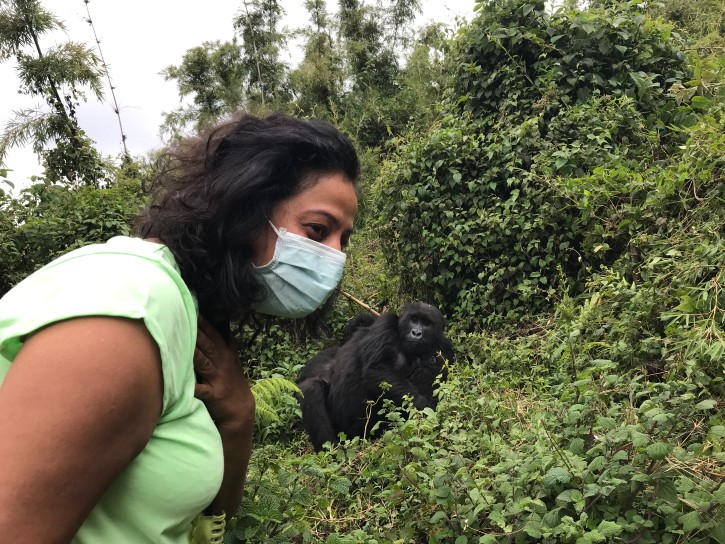
Masks in place, we peer through the bushes and finally see our family. It is about time too. There, in front of us, in a partially open space, is a beautiful gorilla family – lead by a silverback who is currently being groomed by a female and gazes at us uninterestedly. The young ones are playing hide-and-seek, a pregnant female watches the infants weaving in and out of bamboo thickets, rolling around happily. No one is particularly interested in the human group.
It is the young ones that hold my attention. I watch while the rest of the group go crazy with their cameras. My thoughts race to my little nephews and nieces as I watch the young ones – there is so much similarity in their playfulness. Unmindful of the watchers, they somersault, snarl, fight, tug, cuddle and pull all at the same time. A little fellow even thumps his hairy little chest in glee. Patrick points to one little fellow and tells me that he is soon going to get a name. I refrain from asking him. But more on that later.
From time to time, Patrick reminds us to maintain a safe distance from the gorilla family, warning us of their unpredictable behaviour. The silverback continues to ignore us.
I spend an hour in the company of these gentle and mysterious animals, watching them cruising through their daily routine, happy in their family.
An hour later, we take out last best shot with the gorillas with Patrick urging us to “take the best ever memory” with us. That is why I feel doubly fortunate that I could do this for the second time. Mountain gorillas exist in extremely remote locations which means visiting them isn’t easy or cheap but like most wildlife encounters in Africa, the experience is completely worth it. I am yet to hear anyone say otherwise.
This trek, however, is my run up to Kwita Izina, an important cultural event in Rwanda that involves the naming of baby gorillas. In a few hours I would know the name of the youngest member of the Muhoza family in the event to be held virtually (covid protocol) in Kigali Convention Centre.
Kwita Izina
I am amazed how the entire country unites for this event – which is usually held at the Park headquarters in Kinigi and attended by international celebrities including footballers, conservationists, models and the President himself and marked by traditional music, dancing and performances from local students and artists.
Kwita Izina helps to create awareness about gorilla conservation worldwide, drawing thousands of visitors from around the world. Since the inception of this event, 328 baby gorillas have been named. Before 2005, the name of the infants was left to the rangers and researchers who worked with them, before which Dian Fossey and her team had adopted the practice of naming the gorillas.
The tradition of naming a newborn human baby, after which Kwita Izina is named, is a centuries old Rwandan culture. Traditionally, the names are selected based on the infant’s behaviour and character traits, which the Rwandans believe will help in shaping its future.
Trekking through the jungle to see them is a major revenue earner for the Rwandan Government. It costs $1,500 per person for the permit. Part of the earnings is spent on community welfare and conservation initiatives. Though expensive, in my view, every dollar spent is worthy for this once-in-a-lifetime experience.
Useful Info
- There are 12 gorilla-groups which can be visited.
- Each trekking group consists of not more than 8 people and time allowed to be with the gorillas is one hour after finding them.
- It is essential to keep your mask on during the gorilla interaction to prevent transmitting human infections.
- The trek can vary from at least one to 4 hours (or more) depending on the group’s location within the sanctuary.
- Permit costs 1500 USD (500 presently, thanks to COVID)
Trek Essentials
- Boots: Invest in a good pair. No sneakers please!
- Gloves: Prevents your hands from being scratched.
- A light rain jacket: there is always a chance of rain here.
- Energy snacks: For those short breaks to restore your energy.
- Water
- Long pants and shirts: Prevents cuts, scratches and being bitten by fire ants.